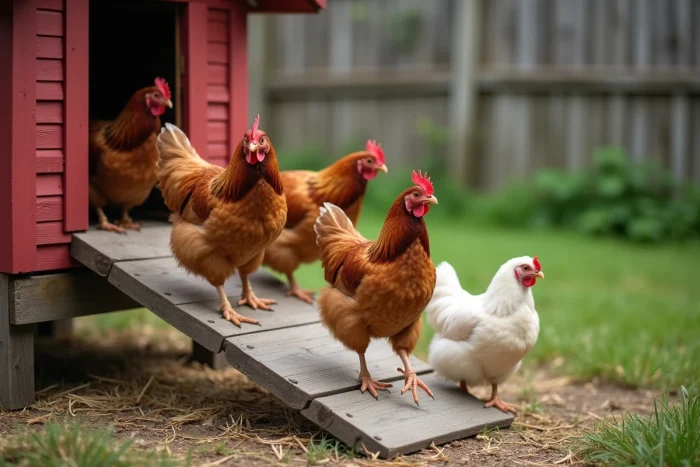
A hen that hesitates to return to its coop in the evening, that jumps heavily from a perch that is too high, or that stays on the ground because it cannot access the elevated nesting box: these situations are common in most domestic setups. The chicken ladder addresses these mechanical issues by providing gradual access, tailored to the morphology of poultry.
Inclusive Chicken Ladder: Access Suitable for Older or Overweight Hens
Accessibility in a chicken coop is rarely discussed. The term seems reserved for human buildings, but the principle directly applies to poultry. An older hen, an overweight hen, or a heavy breed like the Brahma does not have the same jumping ability as an eight-month-old Leghorn.
The challenge is to design a ladder that remains comfortable for healthy hens while allowing secure access for less mobile individuals. A low-slope ladder with closely spaced rungs reduces joint impact during descent, preserving the legs and keel in the long term.
It is advisable to use a chicken ladder from the building’s design stage, not as an afterthought. By integrating the access ramp into the initial plan, the height of the perch and the incline of the ladder can be adjusted without compromise.
Specifically, flat rungs (rather than round ones) provide a better support surface. A reduced spacing between each rung allows hens to ascend step by step without the need for propulsion. Feedback varies on the ideal slope depending on the setup, but a moderate angle, significantly less than 45 degrees, suits most situations.
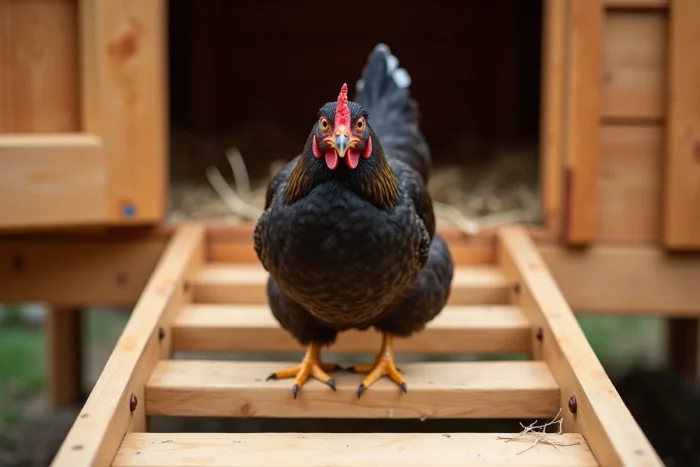
Ladder with Predator Protection Cage
An elevated chicken coop protects hens from moisture and complicates access for pests. The ladder, however, can become an entry point for a fox or a marten if left open at night.
Manufacturers now offer ladders with protective cages or side panels. The principle is simple: the access ramp is framed by panels that channel the hens’ passage through a narrow corridor.
- The fox cannot slip in sideways to reach the hatch, as the walls block diagonal approaches.
- The marten, which easily climbs a bare board, is hindered by the cage that limits its grips and progress.
- The hens, meanwhile, ascend and descend normally in the corridor, guided by the walls without being obstructed.
This type of protected ladder remains uncommon in general public guides. It is mainly found with artisans specializing in elevated chicken coops. Combined with an automatic hatch that closes at dusk, the secure access corridor eliminates the main weak point of elevated chicken coops.
Role of the Ladder in Managing Traffic in the Coop
In a group of six to eight hens, social hierarchy dictates who accesses resources first. The highest perch, the best-placed nesting box: everything is subject to competition. Without a ladder, dominant hens jump directly, while the submissive ones wait or give up.
The ladder serves as a traffic regulator rather than just a simple accessory. By imposing a single, sequential passage, it reduces jostling at the entrance of the coop in the evening. Each hen ascends at its own pace, in order, which decreases stress and pecking related to crowding.
The same effect is observed in the morning. When the hatch opens, hens descend one by one instead of jumping down in a group from the perch. Repeated impacts on the ground, which weaken joints and pads, are avoided.
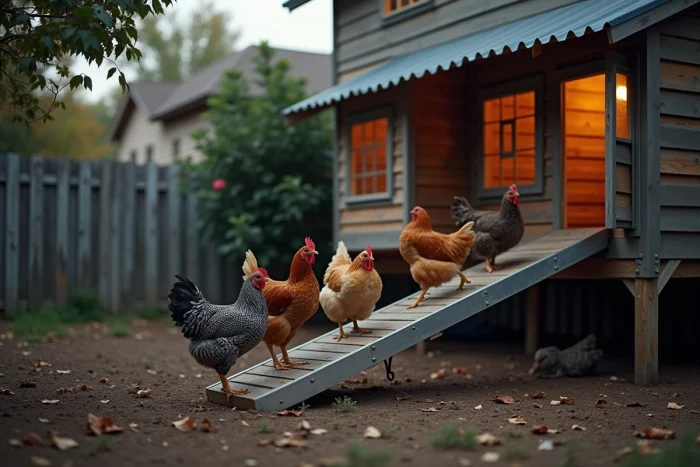
Materials and Maintenance of the Wooden Ladder
Wood remains the material of choice for a chicken ladder. It provides a natural grip for the feet, does not slip when wet (unlike smooth metal), and integrates well into the garden’s aesthetics.
Some points to be cautious about:
- Choose untreated wood, as hens peck and scratch everything under their feet. Untreated pine or larch works well.
- Lightly sand the rungs to avoid splinters, without making them too smooth: a slightly rough surface ensures grip.
- Clean the ladder during coop cleaning. Droppings accumulate on the rungs and become a bacterial breeding ground if left to dry in thick layers.
- Check the stability of the fastenings at least twice a year. A ladder that moves or tips under the weight of a hen creates a panic situation in the group.
Positioning the Ladder in the Coop and Run Space
The placement of the ladder alters the flow throughout the space. Placed against the wall of the coop, it takes up less space in the run but imposes a steeper angle. Positioned diagonally with enough setback, it offers a gentle slope but encroaches on the grassy path.
It is beneficial to position the ladder on the side opposite the waterer and feeder. Hens descending in the morning naturally head towards food: if the ladder ends right in front, a bottleneck is guaranteed. Shifting the ladder’s arrival creates a natural flow of movement in the run.
For an elevated coop with a nesting box accessible from the outside, the ladder should be placed on the run side, not the garden side. Hens quickly associate the ladder-hatch-perch route with their evening routine, and any change to this path causes a few days of disorientation.
The chicken ladder is not a decorative accessory. It structures access, protects the hens’ joint health, limits hierarchical conflicts, and, with a protective cage, enhances security against predators. A modest investment that changes the daily life of the coop in the long term.