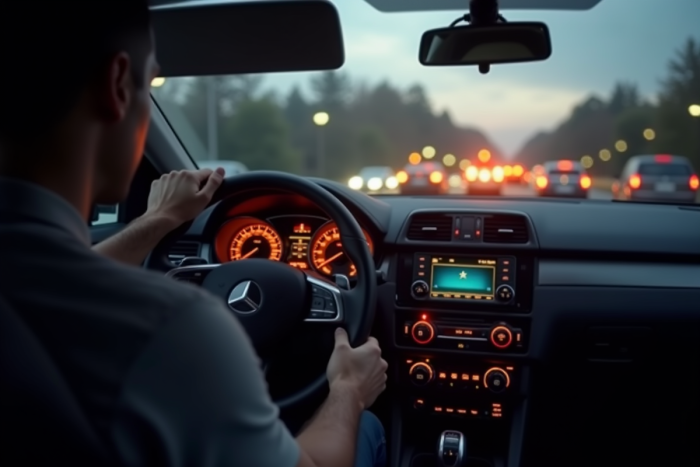
An orange warning light may appear without causing an immediate stop, while a red signal requires a quick reaction without hesitation. Some symbols persist even after intervention, waiting for the electronics to update. And then, there are those sneaky alerts, rare and discreet, that betray a real failure while everything seems to be running smoothly.
Another scenario: some indicators light up at startup, then disappear immediately without any action on your part. Even more surprising, the absence of a warning light can itself indicate a system malfunction. While many drivers fall prey to misinterpretations, these errors often lead to unnecessary interventions… or worse, to avoidable damage.
Why do these lights come on: understanding the dashboard language without stress
The dashboard of a modern car is no longer just a simple alignment of bulbs. It is a true communication center, where each light conveys precise information about the vehicle’s health. An orange light draws attention to an anomaly to monitor, while a red light demands an immediate stop. When a pictogram related to the braking system, oil pressure, or coolant lights up, it is never a trivial detail: it is a warning signal that the driver must take seriously, without succumbing to panic.
When faced with an illuminated dashboard, the first step is to identify the color and symbol of the indicator. The dashboard indicators are often standard, but each manufacturer has its own subtleties. Take the example of a Peugeot: the question of 206 lights illustrates the complexity of these systems. Behind each icon lies a function, a degree of urgency, a level of severity. To navigate through this without wasting time, a look at the guide “Understanding the list of dashboard lights on a Peugeot 206” on Voiture Valk can provide clarity, whether you are a diagnostic pro or simply curious.
If the dashboard lights have multiplied over the years, it is a direct consequence of the improvement of onboard electronic systems. The ESP, tire pressure monitoring, maintenance reminders, airbag monitoring… all this arsenal serves to enhance road safety and anticipate mechanical troubles. Far from being mere gadgets, these signals form a technical language, designed to protect both the mechanics and its passengers. It is enough to decode this language and respond wisely: each light invites action, never panic.
From alert to breakdown: how to react to signals for a worry-free drive
When the engine light appears on the dashboard, the color is not a detail. Red or orange, it tells a different story. The nuance lies primarily in the degree of urgency: orange signals an anomaly to monitor, red demands an immediate reaction. When faced with an illuminated red light, do not wait: engine overheating, insufficient oil pressure, or too low coolant level require stopping the vehicle without delay to avoid serious complications.
Let’s take a concrete case: on a national road, the appearance of a battery light or an oil pressure light does not require the same reaction as a simple airbag or ABS indicator. If the braking system joins the party, vigilance is essential: between worn pads, tired discs, or insufficient brake fluid level, any doubt should trigger a quick check.
To understand what your car is trying to tell you, the diagnostic tool becomes a valuable ally. It allows you to read the error codes and precisely identify the source of the problem: DPF failure, transmission issue, or simply engine oil level to be reviewed. This analysis avoids navigating blindly and guides you towards the appropriate solution.
Here’s how to react concretely when a light comes on:
- Turn off the engine if the temperature rises or if the oil pressure suddenly drops.
- Check the levels, especially oil and coolant, before getting back on the road.
- In case of doubt or persistent messages, consult a professional or arrange for assistance for a thorough car diagnosis.
Mastering the alert involves careful reading of the dashboard and a response appropriate to the situation. Nothing replaces experience, but vigilance is learned, one signal at a time.
The next time a light appears, take a deep breath: the dashboard is not a trap, but the best ally to keep the road under control.