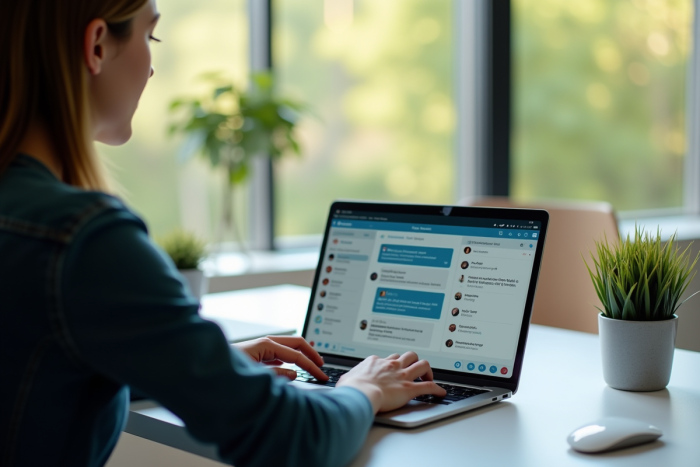
Four times more daily users on Slack in two years. However, 37% of employees find they are losing efficiency due to digital cacophony. Some companies cut notifications at the source to avoid burnout, while others impose a single channel, even if it disrupts habits. The avalanche of tools does not guarantee performance or serenity. With every choice, the balance of remote work and team cohesion is at stake.
Remote work in practice: an overview of essential tools for effective collaboration
Working remotely is not just about seeing faces on a screen. Depending on their job and role, everyone relies on their own combination of digital tools to foster collaboration. To structure exchanges, instant messaging forms the backbone of information. Alongside it, project management, file sharing, and cybersecurity quickly become inseparable from daily life. Access to cloud allows one to retrieve documents from anywhere, while a VPN protects sensitive data during remote connections.
Technical teams, for their part, rely on shared repositories and online workshop tools to move forward together, each from their own desk. Designers prefer collaborative graphic design platforms and digital whiteboards, where ideas flow freely. Collaborative workshops, supported by ideation or wireframing solutions, make it possible for everyone to get involved, regardless of profession or time zone.
Maintaining psychological balance is not a detail. Routines, breaks, a dedicated workspace, and even some well-being apps contribute to sustaining the distance. Added to this are access rights management, two-factor authentication, and ongoing training: all barriers against digital vulnerability and for confidentiality.
To manage emails, electronic messaging remains essential. Accessing messages from anywhere becomes a concrete issue: the IA44 webmail meets this need for flexibility and security, especially for those who want reliable, optimized, and protected access. Having numerous tools does not exempt one from building a coherent strategy, designed for fluid exchanges, information protection, and team dynamics, even remotely.

Messaging, project management, video conferencing: how to choose the solutions that suit your needs?
In the face of the abundance of collaborative tools, the choice deserves careful consideration. Team messaging regulates exchanges, channels information, and lays the foundation for solid cooperation. Video conferencing platforms orchestrate meetings, workshops, regular check-ins, or presentations, and allow for maintaining a human connection, even when spread across multiple sites.
When it comes to remote project management, the alignment between concrete needs and functionalities makes the difference. Some prefer visual interfaces with boards, while others opt for modular workflows or document centralization. The task management tool must adapt to role distribution, prioritization, and collective tracking of progress.
Here are the key criteria to watch for when selecting tools:
- The security of exchanges and documents is non-negotiable: data encryption, enhanced authentication, precise access management.
- File sharing, electronic signatures, and team design solutions add flexibility and facilitate innovation.
- Well-being at work also comes from tools that promote disconnection, work-life balance, and mutual listening.
To access your professional messaging from any device, the IA44 webmail offers a smooth and secure experience. Before multiplying platforms, it is better to assess compatibility, ease of use, and the support offered. Seeking coherence often means giving oneself the means to work better together, even remotely.
Remote work is not only about the performance of tools but also about the ability to forge connections, protect information, and give meaning to the collective, screen or not. It is up to each person to invent their balance, and why not, to rewrite the codes of remote work.