Belgium attracts travelers every year in search of nature weekends, urban heritage, or unusual stays. The choice of accommodation influences the experience as much as the destination itself. However, behind the facade of booking platforms, the fragmented Belgian regulatory framework, divided among three regions with distinct rules, impacts the actual available offer and the reliability of listings.
Regulation of Tourist Accommodations in Belgium: Three Regions, Three Regimes
The tourist rental market in Belgium does not operate as a unified whole. Each region applies its own registration obligations, which directly alters what travelers find online.
In Wallonia, since July 1, 2025, all tourist accommodations must be registered with Tourism Wallonia and have a BELWAL number before being rented out. In Flanders, the declaration to Toerisme Vlaanderen also applies to occasional rentals. Brussels imposes its own registration regime, sometimes supplemented by urban planning requirements.
For travelers, checking for a regional registration number on the listing remains the most reliable way to ensure that the accommodation meets current standards. International platforms do not always display this information prominently.
Meanwhile, some municipalities in the Ardennes add local constraints that go beyond regional rules, such as limitations on the distance between cottages or conditions related to the owner’s residency. This overlap makes understanding the market more complex than a simple star or price ranking. Travelers looking for accommodation on Aventures Légendaires access a selection already filtered according to these adventure and compliance criteria.
Fire Safety and Accessibility Standards: What Accommodation Listings Conceal
Fire safety is an operational criterion often overlooked by travelers, yet it is crucial to the actual quality of a stay. In Flanders, every tourist accommodation must have a fire safety certificate. This requirement applies even to small seasonal rentals.
In Wallonia and Brussels, the requirements vary depending on the capacity and type of structure. A rural cottage for four people is not subject to the same checks as a twenty-room hotel. On-the-ground feedback varies on this point: some owners report long delays in obtaining the certificate, which leads some of them to operate without up-to-date documentation.
Accessibility for people with reduced mobility is improving, especially in urban structures. Brussels has developed a dedicated system through Visit Brussels, but the offer in rural areas (Ardennes, Gaume, Campine) remains significantly more limited. If this criterion is important for your stay, it is better to contact the host directly rather than relying on the icons on the platforms.
Unusual Accommodation in Belgium: Between Glamping, Cabins, and Nature Domains
The segment of unusual accommodation has grown significantly in recent years. Treehouses, transparent bubbles, yurts, caravans: the offer now covers most of Belgian territory, with a notable concentration in the Ardennes and around Durbuy.
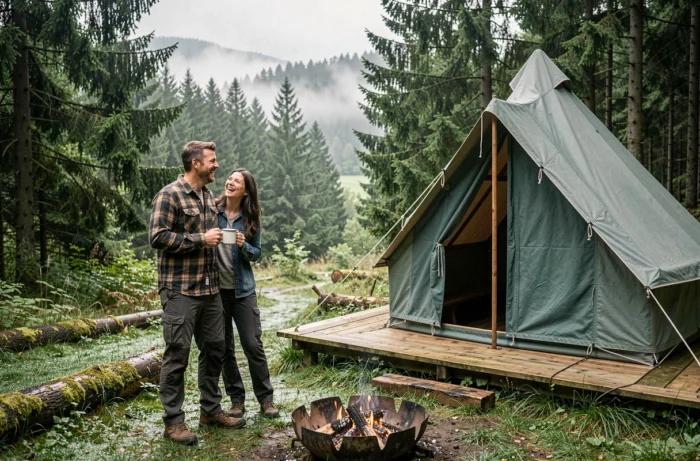
Glamping in the Ardennes attracts a clientele seeking a nature immersion without sacrificing comfort. The domains often offer packages that include breakfast, spa access, or guided activities (kayaking, hiking, adventure courses).
- Cabins and lodges in the forest provide complete disconnection, but their road accessibility can be problematic in winter, especially in the narrow valleys of the province of Luxembourg.
- Bubble or transparent dome accommodations appeal for their originality; however, their sound and thermal insulation varies greatly from one provider to another.
- Holiday homes in a nature park (like Floreal or equivalent) combine autonomy and on-site services, a compromise suitable for families with children.
The price for a night in unusual accommodation generally exceeds that of a classic cottage. Availability remains tight during Belgian school holidays and the May long weekends, periods when booking several weeks in advance becomes almost mandatory.
Stay in a Hotel or Cottage: Decide Based on Duration and Travel Plans
The choice between a hotel and a cottage is not just a budget question. It mainly depends on the length of the stay and the type of activity planned.
For an urban weekend in Brussels, Antwerp, or Ghent, the hotel remains the most practical format. The density of the offer allows finding well-located establishments near public transport and points of interest. Belgian charming hotels and boutique hotels often provide a higher level of personalization than international chains.
For a nature stay of four nights or more, the cottage has the advantage. The ability to cook, have outdoor space, and live at the pace of the place changes the dynamics of the trip. The Belgian Ardennes concentrate the majority of the offer in holiday homes, with options ranging from isolated cottages to domains with shared pools.
- A two-night city stay favors the hotel for its flexibility in arrival and departure.
- A family stay of one week in Gaume or Campine makes the cottage more economical and comfortable.
- Solo travelers or couples who prioritize experience increasingly choose guest rooms with dinner, a typically Belgian format that allows discovering local cuisine.
The Belgian tourist accommodation market is gradually being structured under the influence of new regional obligations. This evolution benefits attentive travelers, who can now more easily distinguish compliant structures from vague listings. Regardless of the chosen format, checking the regional registration number and contacting the host before booking remains the most useful precaution.