When you enter an accessory shop in Paris, Lyon, or Antwerp, the displays tell a clear story of change: delicate rings with clean lines, asymmetrical chains, mismatched earrings worn on one ear. These Korean-inspired pieces are occupying an increasingly visible space in European fashion, and their rise is based on much more concrete mechanisms than just a simple K-pop trend.
REACH Compliance and Chemical Standards: The Filter That Sorts Suppliers
Regulation is rarely the starting point when discussing jewelry, and this is precisely where part of the Korean success in Europe lies. Jewelry sold in the European Union must comply with the restrictions of the REACH regulation, particularly regarding nickel, lead, and cadmium. In practice, distributors now require test reports that precisely identify the model or component tested.
Structured Korean brands, often backed by traceable industrial production chains, are able to provide this documentation. This is a direct operational advantage over suppliers who rely solely on an aesthetic promise without material traceability. Chemical compliance is becoming a measurable commercial advantage for brands that can document their alloys.
This can be seen by browsing the Bijoux Aurea collection, which features pieces designed to meet this requirement while maintaining the characteristic minimalist aesthetic of Korean design.
Korean Aesthetics and European Style: Why Minimalism Works Here
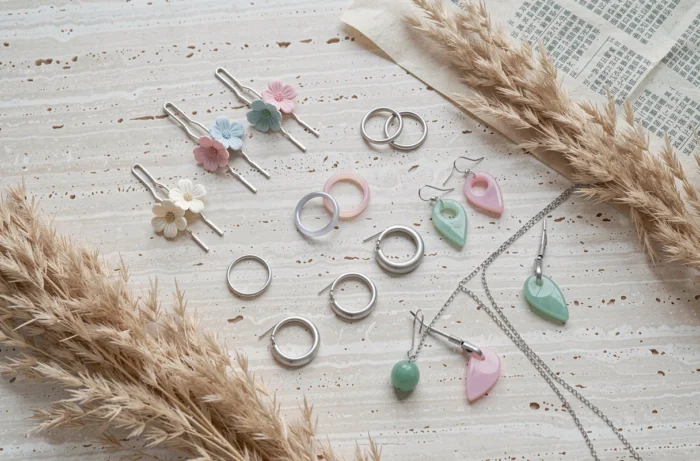
Contemporary Korean jewelry is based on a recognizable formal vocabulary: soft geometric lines, reduced volumes, and satin finishes. This aesthetic choice resonates naturally with a European audience already familiar with Scandinavian minimalism or Japanese design.
The difference lies in the entry price. While European jewelry positions its contemporary creations in high price ranges, Korean brands offer pieces in silver, gold-plated, or stainless steel at accessible prices, without sacrificing finish. You end up with a piece of jewelry that works just as well with a turtleneck during the week as it does with an evening outfit.
What K-Culture Has Changed in the Perception of Jewelry
Korean dramas and K-pop artists have helped normalize the wearing of discreet jewelry for both men and women. Feedback on this point varies across European markets, but the trend is clear in major cities: Korean jewelry is no longer seen as a feminine accessory or a fan gadget, but as a legitimate style element.
Kim Jeongchan, founder of the HanO brand in Seoul, exemplifies this dynamic. His work reinterprets the Korean artisanal heritage into contemporary creations showcased at events like the Hanbok Expo. Cultural grounding nourishes creation without freezing it in the folkloric.
Anti-Money Laundering Regulations and Packaging: What Will Change for Jewelry Sellers in Europe
Beyond aesthetics, two European regulatory developments will reshape the market in the coming years.
- The European AML package adopted in 2024 provides for the direct application of anti-money laundering regulations starting July 10, 2027. Sellers of high-value goods, including jewelers, will need to strengthen their customer knowledge and transaction monitoring obligations. Korean brands transitioning from affordable accessory e-commerce to selling more expensive pieces are directly affected.
- The European regulation on packaging and packaging waste (PPWR) imposes new constraints on packaging. However, packaging is a strong component of the customer experience in Korean jewelry, often meticulously done up to the ribbon. Adapting packaging to PPWR requirements without degrading the unboxing experience becomes a concrete challenge for exporting brands.
- Product declarations for packaging require brands to document each reference, which favors organized structures capable of managing a regulatory catalog alongside the commercial catalog.
These constraints do not hinder the spread of Korean jewelry in Europe. They restructure the market by eliminating opportunistic resellers and consolidating the position of brands that invest in compliance.

Korean Jewelry in Europe: Beyond Statutory Luxury
In Korea, jewelry is often associated with a status logic, linked to objects that one wears or displays. In Europe, the reception is different: Korean jewelry appeals for its design, not for its displayed price.
This distinction matters. European consumers purchasing Korean-inspired pieces are not looking to display social status. It is more about accessible art, contemporary creation integrated into daily life. Korean jewelry in Europe functions as a personal style object, not as a class marker.
The Role of Digital Distribution Channels
E-commerce platforms and social media have shortened the distance between Seoul and European buyers. Korean brands master the visual codes of Instagram and TikTok, with clean product staging that meets the expectations of an audience accustomed to polished content. The online gallery replaces the physical showcase, and brands that document their creation process gain credibility.
The KOTRA agency (Korea Trade-Investment Promotion Agency) also supports Korean brands in their international expansion, facilitating access to trade shows and European distributors.
Ultimately, the success of Korean-inspired jewelry in Europe is due to a combination of factors rarely found together: a readable aesthetic, industrial capacity to meet European standards, and a brand culture designed for the digital realm. Upcoming regulatory deadlines, particularly the 2027 anti-money laundering regulation and new packaging rules, will further strengthen the advantage of structured players in this market.