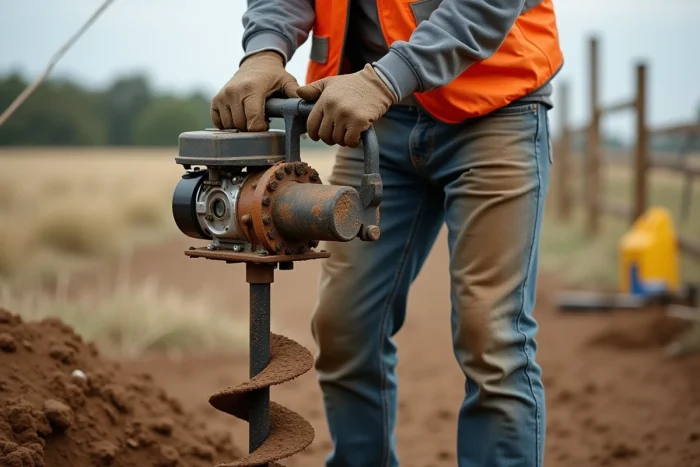
Digging your own well to water the garden without relying on the public network is an achievable project with the right equipment. The auger allows for drilling holes in various soils, including clay or compacted ones, where a manual auger would quickly reach its limits. However, it’s essential to know how to prepare the ground, choose the right accessories, and protect the drilling over time.
Clay, sandy, or rocky soil: adapting the bit to the terrain
Before even starting the engine, the type of soil conditions everything that follows. Sandy ground drills easily, but the walls collapse quickly. Clay soil resists the bit more, but it sticks to the blades and slows down progress. Rocky terrain can abruptly block the rotation.
Have you ever observed the soil in your garden after heavy rain? If it forms a sticky mud, you are probably on clay. If it flows between your fingers, it’s sand. This simple observation guides the choice of the bit.
For compact soil, a large diameter bit (around 250 mm) with reinforced blades is preferable. In loose soil, a smaller diameter is sufficient, but a quick pre-tubing will be necessary to prevent wall collapse. When deciding to perform a manual well drilling, this analysis of the terrain helps avoid breaking equipment or wasting hours freeing a stuck bit.
Pre-tubing and wellhead protection: two often overlooked steps
Most guides detail the drilling itself but quickly skip over what happens right after. Feedback compiled by the PRACTICA Foundation shows that wells are often clogged a few months after commissioning when wellhead protection is neglected.
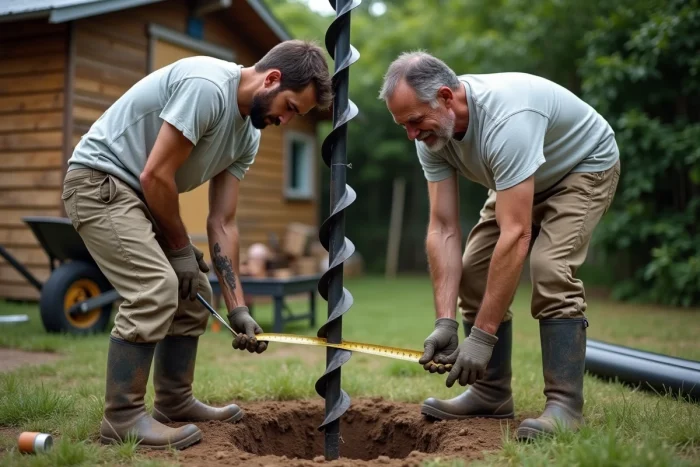
Pre-tubing involves sliding a temporary tube (often made of PVC) into the hole as you go deeper. It keeps the walls in place while you continue to drill deeper. Without it, sandy soil can collapse and fill in the work already done.
The concreted drilling head
Once the final tube is installed, the wellhead should extend about twenty centimeters above the ground. Pouring a small concrete slab around it, with a peripheral drain, prevents runoff water from seeping into the well. This precaution is valid even for a small garden well intended for watering.
A concreted extension protects the well from surface infiltration and significantly extends its lifespan. Without it, bacteria, fertilizers, or pesticides from the garden risk contaminating the aquifer.
Screen and drainage gravel: ensuring sand-free water
The final tube alone is not enough. At its submerged end, a screen (a perforated tube with fine slots) filters the water entering the well. Recent guides from organizations like Fert emphasize the use of screens with fine slots and calibrated gravel, even for small manual drills.
Why this choice? Because a poorly filtered well sucks in sand with every pump. This sand prematurely wears out the surface pump or the engine pump and eventually clogs the tubing. Here’s what to plan for proper filtration:
- A screen with slots adapted to the soil grain size (finer slots for sand, wider for coarse gravel)
- A mass of rolled gravel poured between the tube and the walls of the well, along the entire height of the screen, to slow down the entry of sand
- A PVC bottom cap glued under the screen, to prevent sediment from rising through the bottom of the tube
A good filtering mass reduces sand accumulation and significantly extends the life of the pump.
Safety and declaration: what regulations require
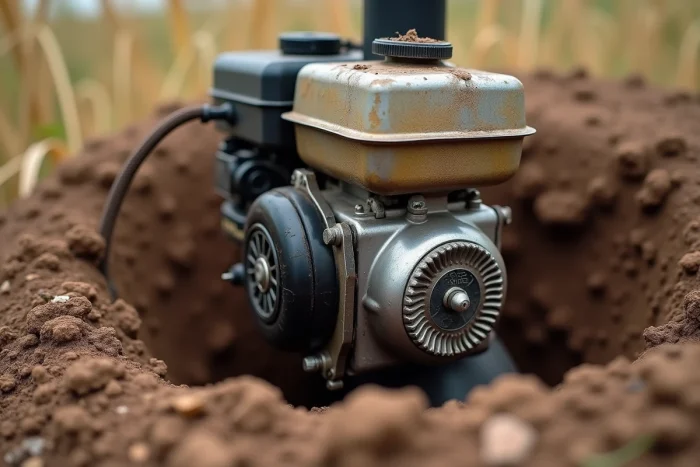
On the equipment side, recent thermal augers incorporate a vibration-damping system and a safety clutch. The clutch cuts off rotation if the bit gets stuck in a root or stone, preventing the machine from slipping out of your hands. Check for this feature before purchasing or renting.
Declaration at the town hall
In France, the decree of September 11, 2003, regarding water extraction regulates domestic drilling. Several municipalities now require a prior declaration even for shallow wells intended for watering. Some also require a backflow prevention device on the internal network to avoid any interconnection with drinking water.
Check with your town hall before starting. Failing to declare a drilling can lead to a fine, and a non-compliant well can cause issues during a property sale.
Maintenance of the well and thermal auger after drilling
Once the well is operational, an annual check is sufficient to maintain its good condition. Here are the points to verify:
- The water level in the well at the beginning and end of the dry season, to detect any drop in the aquifer
- The condition of the screen (pumping that brings up sand indicates clogging or deterioration)
- The head slab and the peripheral drain, to ensure that no cracks allow surface water to pass through
- The flow rate of the pump, which gradually decreases if the filtering mass becomes clogged
For the auger itself, cleaning the blades after each use and regularly draining the thermal engine preserves its drilling power. The blades of the bit wear out faster in abrasive soils: inspect them and replace them when they no longer bite into the ground.
A well designed, with solid tubing, an appropriate screen, and a protected head, can provide watering water for many years. The real investment is not so much in the auger as in the quality of the finishing of the drilling.